Written by: DarkWebSonar Research Team
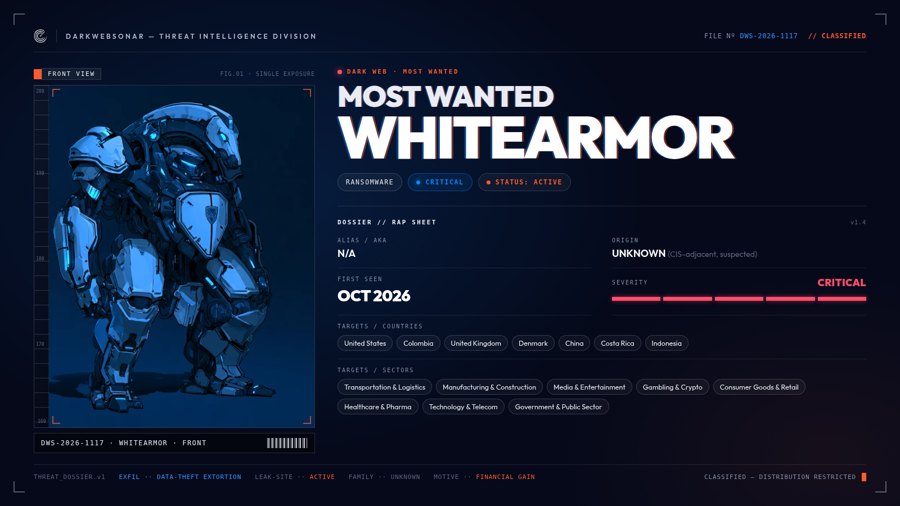
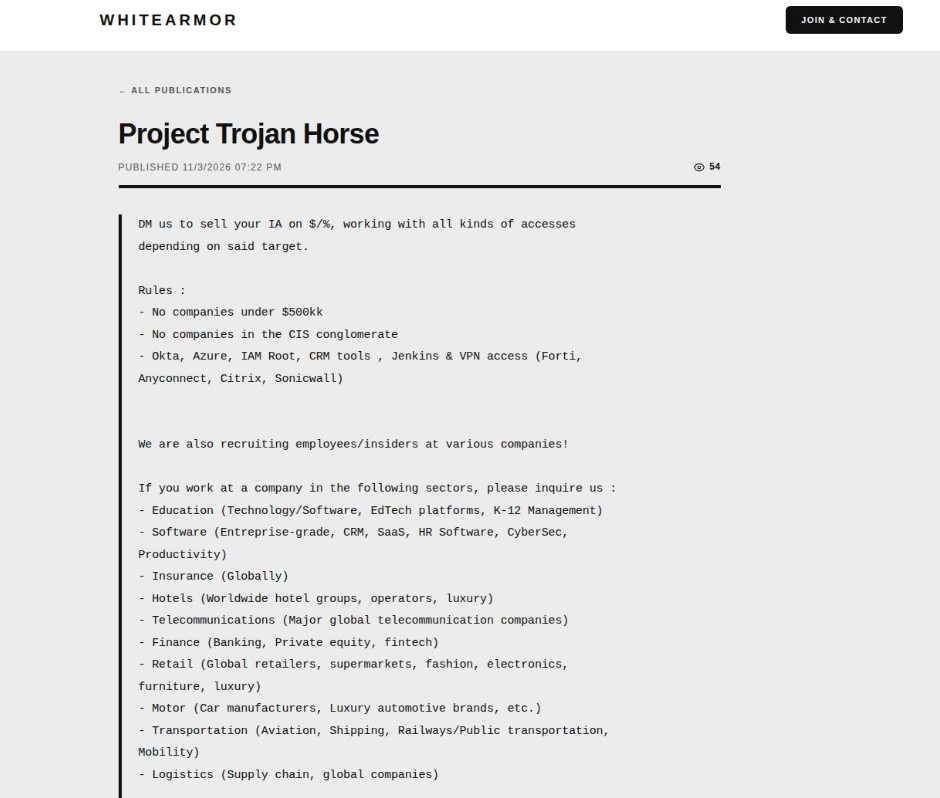
WhiteArmor has named 17 victims on its Tor leak site since 20 October 2026, including Maersk (confirmed breach, $5M demand), Unilever ($15M), Hisense ($5M), J.B. Hunt (disclosed breach, $5M), Ryder ($20M), Echo Global Logistics ($10M), Whirlpool, Disney, and LoveSac. What makes the operation distinctive is not the victim list alone but what DarkWebSonar captured alongside it: a recruitment campaign called "Project Trojan Horse" in which the group openly buys Okta, Azure, IAM, Jenkins, and VPN appliance access (Fortinet, AnyConnect, Citrix, SonicWall) from insiders and brokers, names a $500 million revenue floor for targets, and excludes CIS-region organizations. DarkWebSonar captured that recruitment post directly from the group's own channels, and it is the clearest window into how this operation scales.
No WhiteArmor encryptor, payload, or toolset has been publicly analyzed. The observable pattern is data-theft extortion: every leak-site posting describes stolen data volumes and demands BTC or XMR payment to prevent publication, but no incident report has confirmed ransomware deployment on victim systems. The CIS exclusion is consistent with Russian-speaking or CIS-adjacent crews, though no attribution exists. Maersk confirmed data extraction from an acquired legacy system, and J.B. Hunt has filed breach notifications and faces class actions, giving the group's claims more weight than a typical new-entrant leak site.
Key findings from DarkWebSonar telemetry (through 2026-11-14):
- "Project Trojan Horse" recruitment campaign seeks initial-access brokers and insiders with Okta, Azure, IAM, CRM, Jenkins, and VPN access for organizations above $500M revenue, excluding CIS targets.
- 17 named victims since 2026-10-20 across 7 countries; Maersk and J.B. Hunt have both disclosed related breaches.
- Victim profile is US-headquartered and global Western enterprise: country coding is HQ-based (US 53%), but Maersk (Denmark), Unilever (UK), and Hisense (China) are global multinationals.
- Transportation & Logistics leads industries at 24% (4 postings), with four major logistics firms (Maersk, J.B. Hunt, Ryder, Echo) claimed in a 15-day window.
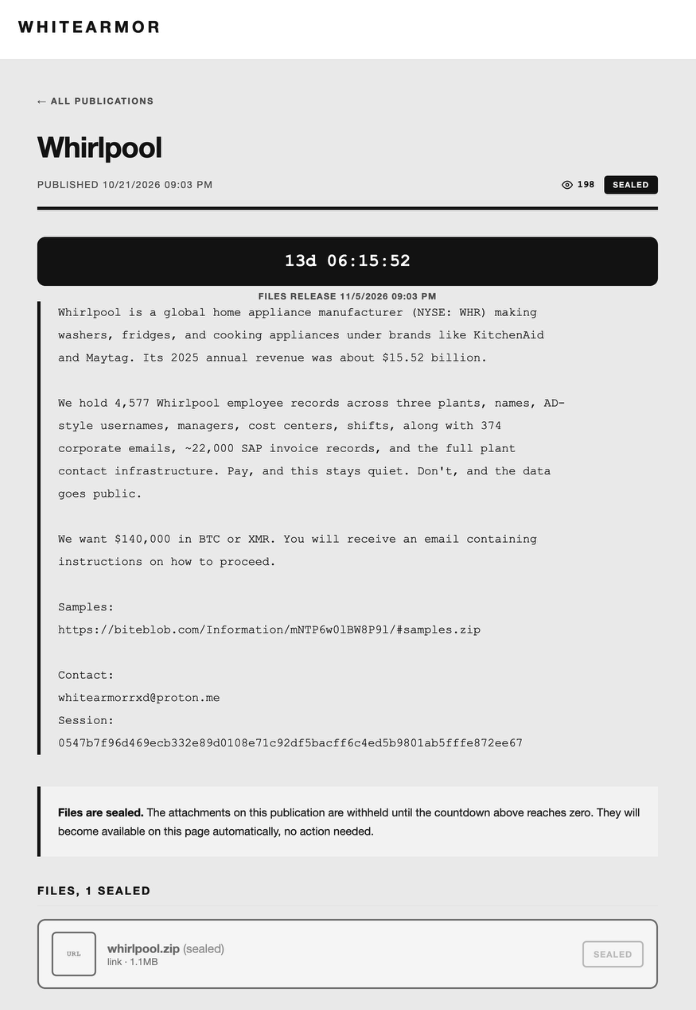
- Ransom demands scale from $140,000 (Whirlpool) to $20,000,000 (Ryder), calibrated to victim size and data scope.
- DarkWebSonar risk score: 98/100 (Critical); activity classification: Spiked.
By the Numbers (DarkWebSonar Telemetry)
DarkWebSonar has monitored WhiteArmor's Tor leak site since its first posting appeared on 20 October 2026. The figures below cover 17 named-victim postings plus 2 "Project Trojan Horse" recruitment posts the group published itself (one on its leak site, one cross-posted to a forum). Every named organization is a claimed listing; only Maersk and J.B. Hunt have publicly acknowledged related incidents.
- Named victims: 17 since 2026-10-20 across 7 countries, 8 industries
- Group postings captured: 19 (17 named-victim listings + 2 "Project Trojan Horse" recruitment posts)
- DarkWebSonar risk score: 98/100 (Critical)
- Activity classification: Spiked. The group's entire observable history falls within one month
- Primary channel: the dark web (Tor) leak site (~95% of postings); the lone clear-web item is the 20 October Disney teaser
- Operational tempo: 5 postings in 2026-W43 (launch week), 9 in 2026-W44, 5 in 2026-W45 (including Maersk and the Trojan Horse recruitment post)
Posting cadence
WhiteArmor launched with a Walt Disney Company staff-directory "teaser" leak on a clear-web forum on 20 October 2026, followed by its first Tor leak-site victim (Whirlpool) the next day. The pace has been consistent rather than front-loaded: 2026-W44 was the peak week with 9 postings (three on 27 October alone: Ryder, Wagyu, and Gamblinglore), and 2026-W45 delivered the highest-profile claims (Unilever on 4 November, Maersk on 7 November).
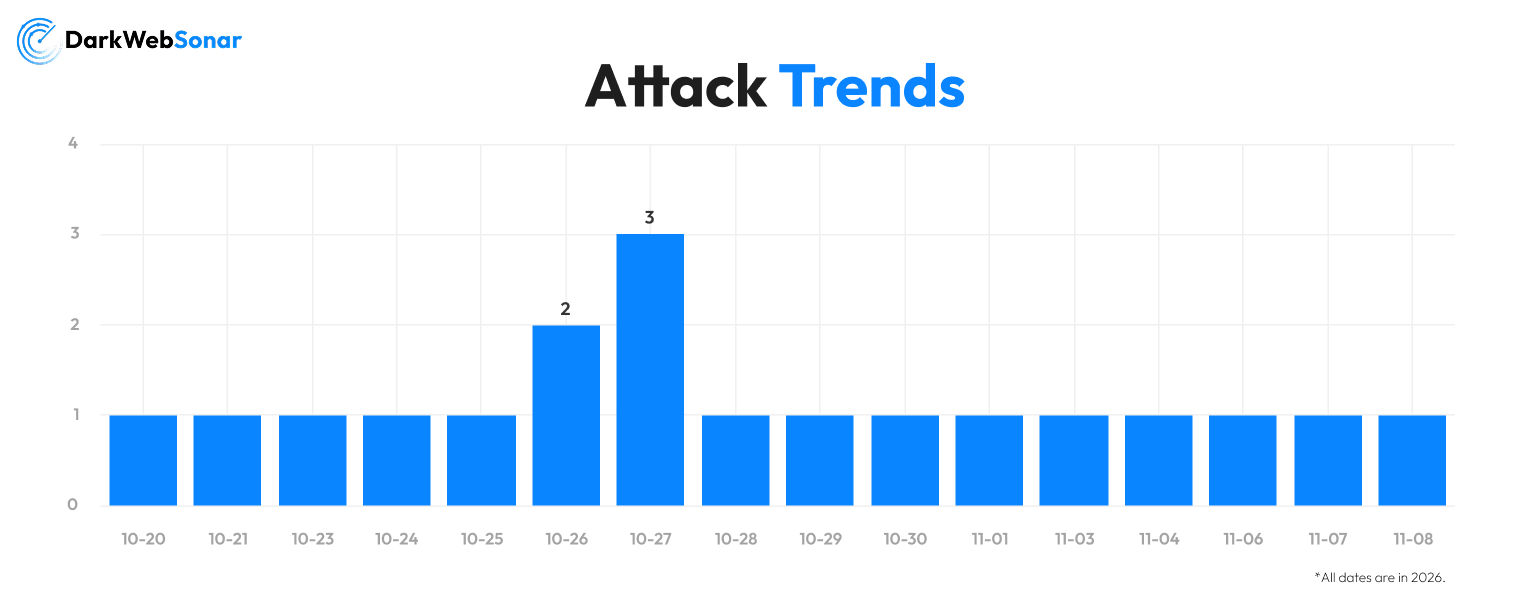
We assess the cadence as sustained output from an access-ready crew rather than a single batch dump. Postings are spaced 1 to 3 days apart, each with distinct victim data and custom demands, rather than the same-day mass publication common in established ransomware operations like SafePay or The Gentlemen.
Targeting distribution: countries
Country coding is HQ-based: the United States leads at 53%, with Colombia (12%), and single entries for China, Costa Rica, Denmark, Indonesia, and the United Kingdom. That headline understates the Western-enterprise reality. Maersk is headquartered in Denmark but operates in 130+ countries; Unilever (UK) and Hisense (China) are similarly global multinationals whose breach exposure extends far beyond one jurisdiction. The practical targeting profile is large Western and global enterprises, not a US-only operation.
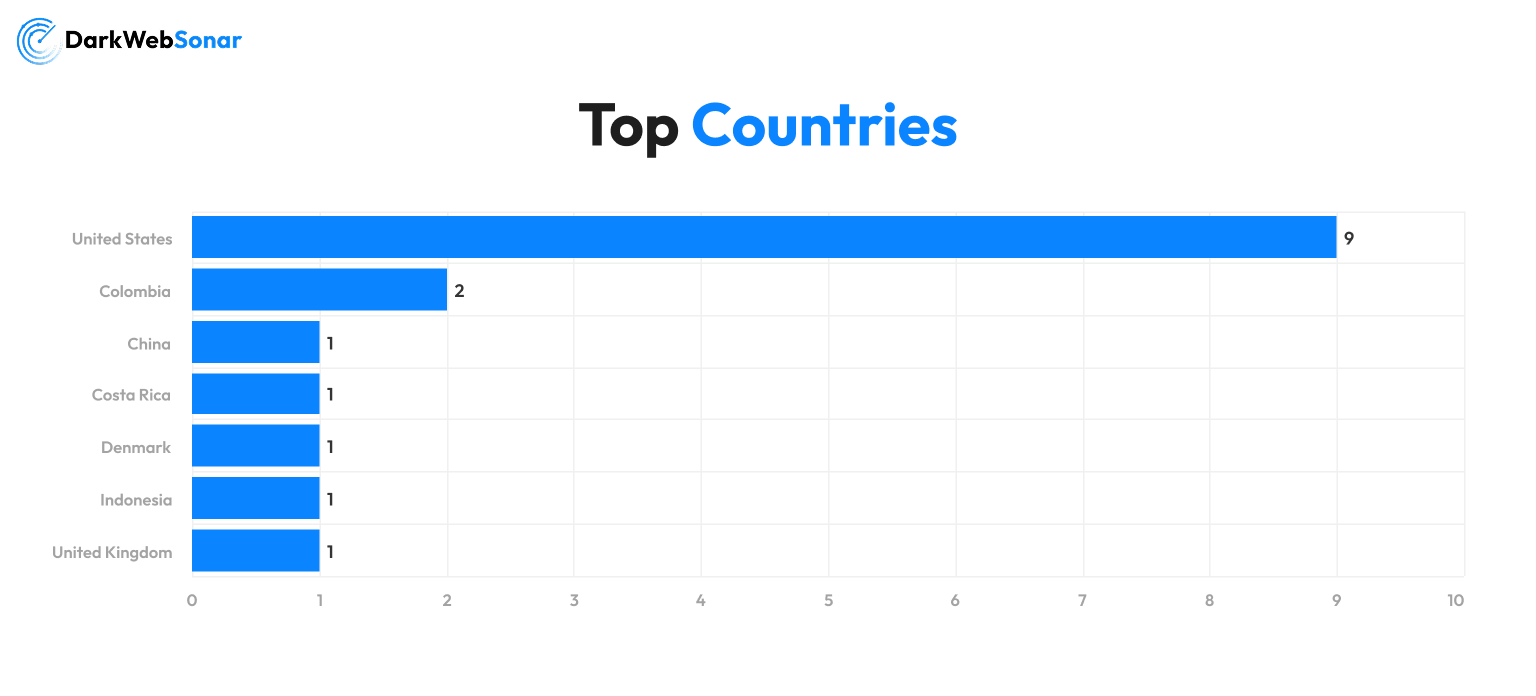
Colombia (Partido Liberal, Clínica La Sagrada Familia) is the geographic outlier, the only non-Western cluster. Read the full map alongside the $500M revenue floor and the picture is a group selecting targets by size and enterprise complexity, not by country.
Targeting distribution: industries
Transportation & Logistics leads at 24% (4 postings), driven by four of the world's largest logistics companies in a single two-week window: Maersk, J.B. Hunt, Ryder, and Echo Global Logistics. Manufacturing & Construction follows at 18% (3 postings: Whirlpool, Hisense, KTU Shipyard). A crypto-gambling cluster runs through the remainder (Gamdom, Rolly, Wagyu, Gamblinglore), alongside Media & Entertainment (12%: Disney teaser and Gamblinglore), consumer goods (Unilever), and healthcare (Clínica La Sagrada Familia).
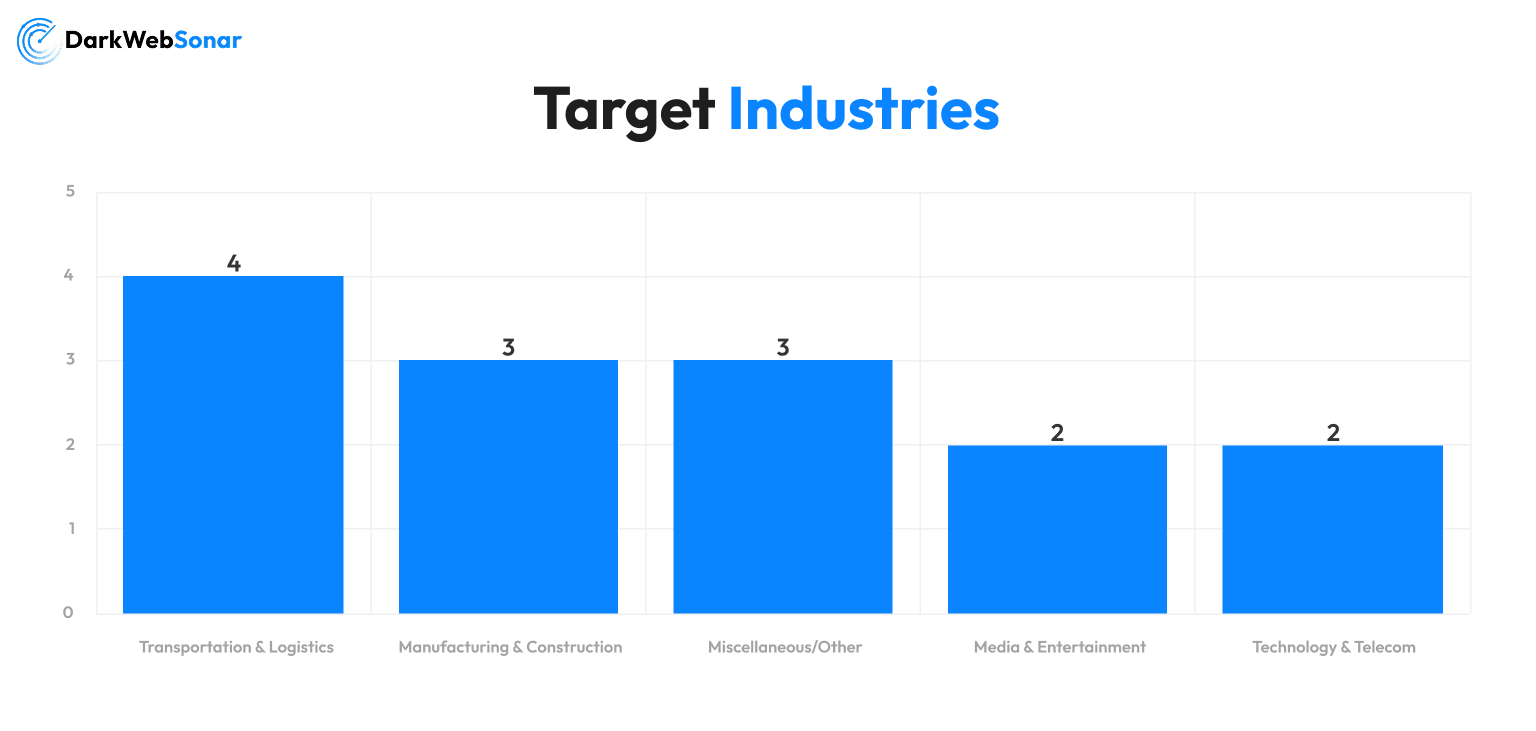
The transportation cluster is the distinctive analytical fact. SafePay and The Gentlemen are manufacturing-heavy at 28% each; WhiteArmor's sector concentration sits in the supply chain layer above manufacturing, targeting the logistics companies that move goods for those same industrial firms.
Tactics, Techniques & Procedures (TTPs)
Our visibility is the leak-site posting, not the victim network: the techniques below are inferred from the posting class, not observed on victim systems. DarkWebSonar's automated technique mapping assigns T1486 (Data Encrypted for Impact) and T1490 (Inhibit System Recovery) across the 17 ransomware-classified victim postings, the generic pair inferred from the posting category. No CVEs, tools, or additional technique tags are in the profile yet. The richer TTP picture comes from WhiteArmor's own "Project Trojan Horse" recruitment posts, which name concrete initial-access vectors the automated mapping does not capture. No encryptor, malware sample, or C2 infrastructure has been publicly analyzed.
Extortion strategy
The observable pattern is data-theft extortion rather than confirmed file encryption: every leak-site posting describes stolen data volumes and demands payment to prevent publication, but no incident report has confirmed ransomware deployment on victim systems.
Demands are scaled to victim size: $140,000 for Whirlpool (a scoped plant-level claim), $500,000 for LoveSac, $2,000,000 for Clínica La Sagrada Familia, $5,000,000 for Hisense, J.B. Hunt, and Wagyu, $10,000,000 for Echo Global Logistics, $15,000,000 for Unilever, and $20,000,000 for Ryder. Payment is requested in BTC or XMR. Contact channels include Session, ProtonMail, and Telegram (@whitearmorsupp).
Initial access: "Project Trojan Horse"
The most operationally useful TTP intelligence comes from WhiteArmor's own recruitment posts, which DarkWebSonar captured on 3 November (leak-site original) and 6 November (forum cross-post).
The posting, branded "Project Trojan Horse," solicits initial-access brokers and corporate insiders and names the access types the group is buying: Okta, Azure, IAM root, CRM tooling, Jenkins, and VPN appliances (Fortinet, AnyConnect, Citrix, SonicWall). The group states two targeting rules: no organizations under approximately $500M annual revenue, and nothing in the CIS region. It actively recruits employees and insiders across education, software/SaaS, insurance, hospitality, telecom, finance, retail, automotive, transportation, and logistics, and offers flat-fee or percentage-based payment with escrow.
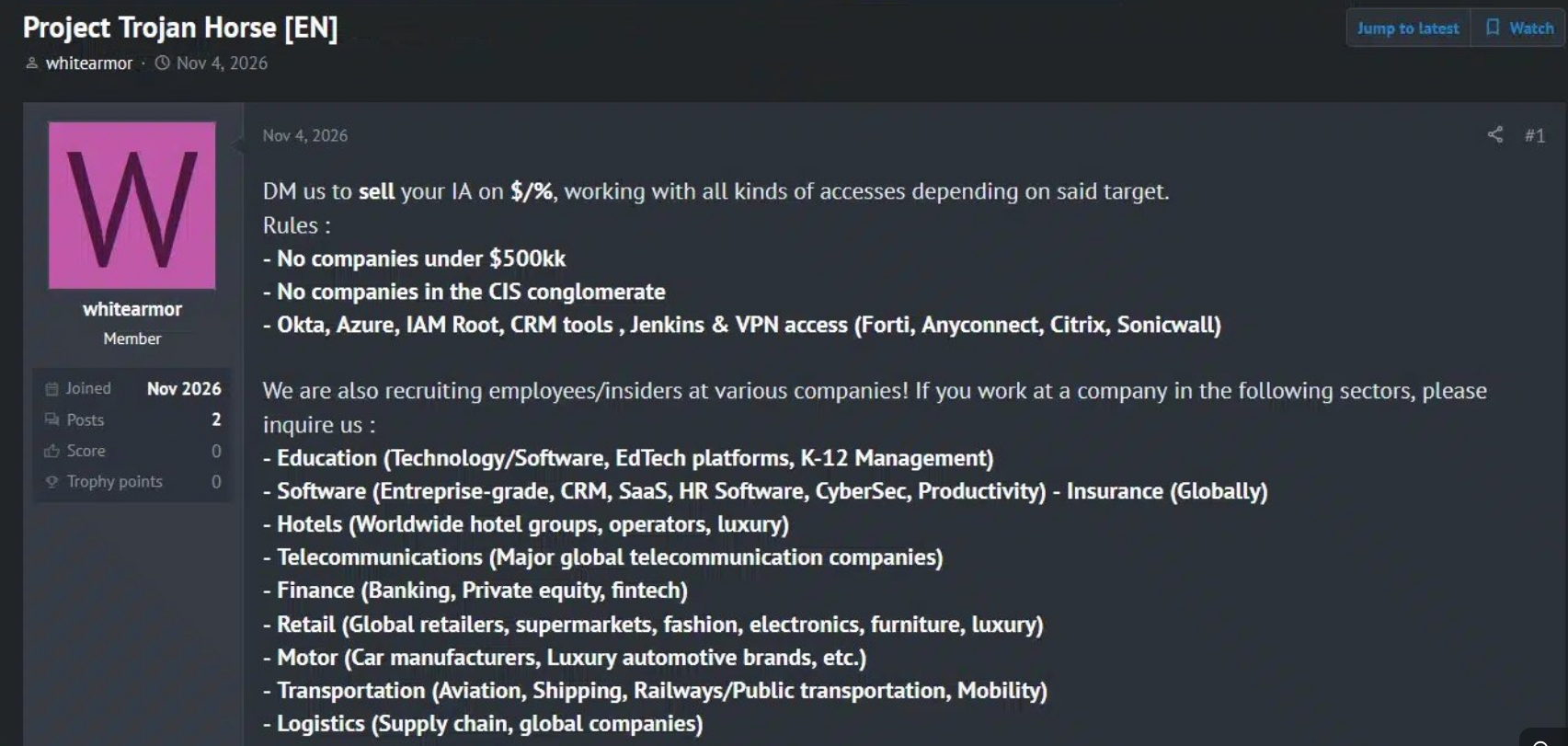
These named access types are the closest thing to a TTP fingerprint DarkWebSonar has observed. They map to capabilities the automated profile does not yet tag: exploitation of external remote services, valid-account abuse, and supply chain compromise via identity and CI/CD platforms. Defenders should treat the Trojan Horse access list as a prioritized hardening checklist.
The specific access vectors behind individual breaches remain unconfirmed. What is verified is that the Maersk breach involved a legacy system inherited through a prior acquisition (Maersk statement), a pattern consistent with the stale-credential and under-monitored-asset risks that the Trojan Horse posting itself targets.
The recruitment posting offers access sellers a flat-fee or percentage-based payout with escrow, per the group's own language. The specific fee split and the full scope of the recruitment pipeline are not independently verified.
Credential and data staging
Claimed stolen material across postings includes Microsoft 365 mailboxes (973 at J.B. Hunt), SAP invoice records (22,000 at Whirlpool, 38.2M at J.B. Hunt), employee PII with government IDs (140,838 at J.B. Hunt, 254,670 patient identities at Clínica La Sagrada Familia), customer databases, cleartext API keys, VPN credentials, and Okta/Office 365 SSO integration details (AmplifAI/GoDaddy instance). The Ryder posting claims 18.75M rows across 328 CSVs. These volumes, if accurate, suggest pre-staging of large database exports before extortion contact.
Evolution & Trends
WhiteArmor's observable history compresses into three ISO weeks:
- 2026-W43 (Oct 20–25): Launch. Disney staff-directory teaser on a clear-web forum (Oct 20), then the Tor leak site opens with Whirlpool (Oct 21), J.B. Hunt (Oct 23), Hisense (Oct 24), and Partido Liberal (Oct 25). Five postings in six days.
- 2026-W44 (Oct 26–Nov 1): Peak volume. Nine postings: three crypto/gambling targets (Gamdom, Rolly, Wagyu), two more transportation firms (Ryder, Echo Global Logistics), plus KTU Shipyard, LoveSac, Gamblinglore, and AmplifAI/GoDaddy. Three postings on 27 October alone.
- 2026-W45 (Nov 2–8): Escalation. "Project Trojan Horse" recruitment post (Nov 3), Unilever $15M demand (Nov 4), forum cross-post (Nov 6), Maersk (Nov 7), Clínica La Sagrada Familia (Nov 8). Maersk is the highest-profile claim; Maersk's public confirmation on 11 November is the strongest corroboration of WhiteArmor's operational capability.
The trajectory is noteworthy: in week one the group tested its infrastructure with a mix of mid-market and large targets, in week two it ramped volume with a broader sector spread, and in week three it hit two of the world's most recognizable brands (Unilever, Maersk) and published its access-buying recruitment campaign. We assess this as a crew that arrived with pre-existing access to multiple enterprises, not a group building capability in public.
Notable Campaigns / Victims
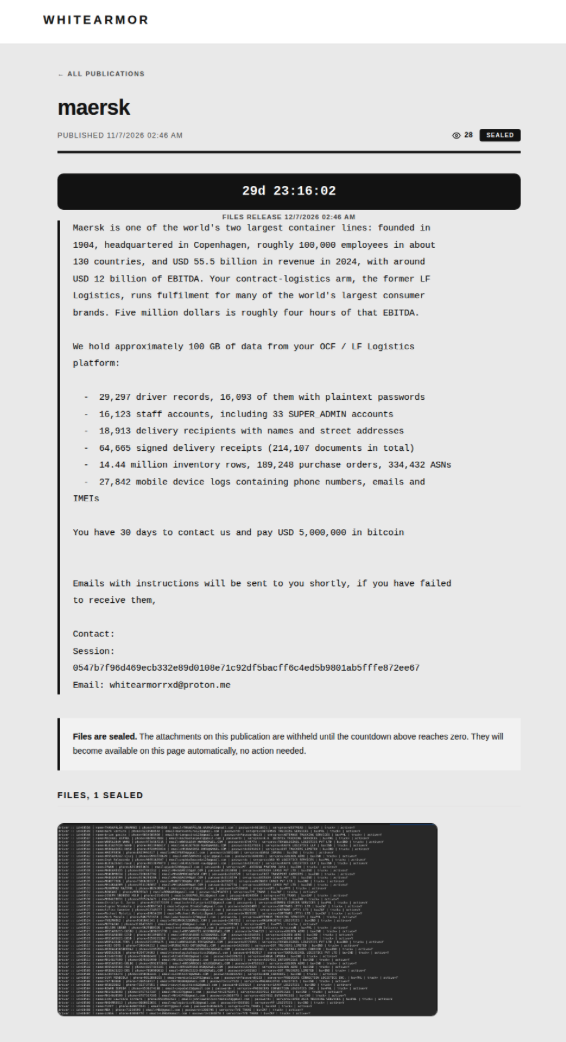
Maersk (Denmark, Transportation & Logistics; 2026-11-07; maersk.com). The world's second-largest container shipping company, with over 10,000 employees and $1B+ revenue. WhiteArmor's posting references a Maersk security-incident disclosure and links a download of claimed data. Maersk confirmed on 11 November that unauthorized access and data extraction occurred from a "local legacy system" from a previous acquisition, and stated the breach was contained and no sensitive data had been disclosed. WhiteArmor claims approximately 100 GB of data from Maersk's OCF/LF Logistics platform (acquired from Li & Fung in 2022), including driver records, admin accounts, and delivery receipts (BleepingComputer). Maersk has not confirmed WhiteArmor's involvement, the claimed data scope, or the $5M demand.
J.B. Hunt (United States, Transportation & Logistics; 2026-10-23; jbhunt.com). North America's largest intermodal provider. WhiteArmor claims 140,838 employee records, 1.7M carrier contacts, 38.2M invoices, and 973 M365 mailboxes, demanding $5,000,000 in BTC or XMR. J.B. Hunt confirmed it was "investigating unauthorized access to certain information within an isolated portion" of its technology system, engaged a cybersecurity firm, notified law enforcement, and revoked the access. Four proposed class actions were filed Oct 27–28 in the Western District of Arkansas, alleging the company failed to protect employee PII (The Loadstar). No class has been certified.
Ryder (United States, Transportation & Logistics; 2026-10-27; ryder.com). Fleet management and supply chain provider (5K–10K employees, $1B+ revenue). Claims 18.75M rows across 328 CSVs, including driver PII, cleartext API keys, and telematics configurations from RyderView, RLM, and EFT systems. $20,000,000 demand in BTC, the largest documented WhiteArmor demand. No public confirmation from Ryder.
Unilever (United Kingdom, Consumer Goods; 2026-11-04; unilever.com). Claims approximately 79 GB of data including 665K contacts, 5.5K OTM accounts with roles and logins, 14M locations, 3.8M shipments, and distributor loyalty profiles. $15,000,000 demand in BTC. No public confirmation.
Hisense (China, Manufacturing; 2026-10-24; hisense.com). The group claims 19 GB of warranty, customer, supplier, invoice, and CRM data with a $5,000,000 demand. Data was published after Hisense did not respond or negotiate. Hisense has not publicly confirmed the breach.
Echo Global Logistics (United States, Transportation & Logistics; 2026-10-28; echo.com). Chicago-based third-party logistics provider (1K–5K employees, $1B+ revenue). Claims 2.06M claims rows, freight loads, quotes, tenders, tracking records, 3,890 employee identity mappings, and carrier records. $10,000,000 demand in BTC.
Gamdom (Costa Rica, Gambling; 2026-10-26; gamdom.com). Crypto casino. Claims 15.4M user entries, KYC selfies, and staff data after failed ransom negotiations. The posting includes allegations about Gamdom's provably fair crash game, a reputational attack layered on top of the data extortion. WhiteArmor stated the Rolly.io breach was motivated by "a joke about Gamdom," suggesting a personal or competitive angle in the crypto-gambling sector.
DarkWebSonar Insights
- Transportation mega-target cluster. Four of the world's largest logistics companies (Maersk, J.B. Hunt, Ryder, Echo Global Logistics) listed in a 15-day window is unprecedented in DarkWebSonar's ransomware monitoring. No other ransomware operation we track has concentrated this much logistics-sector volume in its opening weeks. MSPs and SOCs serving transportation, freight, and supply chain clients should treat this as a direct early warning.
- Revenue-floor intelligence as a targeting signal. "Project Trojan Horse" names a $500M revenue floor and specific access types. That operational intelligence, published on the leak site, is directly actionable: if your organization exceeds that threshold and runs Okta, Azure, Fortinet, or SonicWall, WhiteArmor's recruitment campaign describes you as a target class.
- Corroboration trail. Two of 17 named victims (Maersk and J.B. Hunt) have made public statements or regulatory filings consistent with a breach. That ratio is not unusual for early-stage operations, but both are Fortune 500 transportation firms, which lends weight to the remaining claims in that sector.
- From zero to Malpedia in three weeks. WhiteArmor already has a Malpedia entry and MISP indicators. DarkWebSonar telemetry adds the time-depth layer: every posting from day one, with cadence, targeting, demand amounts, and sector-concentration data.
Defender Outlook 2026
Persistent risk: Organizations above $500M annual revenue in Transportation & Logistics, Manufacturing & Construction, and Consumer Goods should treat WhiteArmor as an active threat. The CIS exclusion and revenue floor define the target set explicitly: large Western enterprises with complex IT environments and legacy systems.
Tempo: Output has been consistent at 5 to 9 postings per week across all three observed weeks. No dormant periods exist yet because the group has no history to compare against. Defenders should expect continued output at this cadence until the group faces operational disruption or law enforcement attention.
Defensive actions:
- Audit internet-facing VPN gateways (Fortinet, AnyConnect, Citrix, SonicWall), identity platforms (Okta, Azure AD), and CI/CD systems (Jenkins). "Project Trojan Horse" names these as desired access vectors.
- Inventory and harden legacy systems, especially those inherited through acquisitions. The Maersk incident demonstrates that acquired systems outside current security controls are targets of opportunity.
- Rotate stale service accounts, machine credentials, and API keys. The Maersk breach involved a legacy system from a prior acquisition; long-unrotated credentials in inherited environments are a natural fit for the access types Trojan Horse solicits.
- Alert on bulk database exports, unusual archive creation, and sustained outbound transfers from employee, customer, invoice, and CRM repositories. Claimed data volumes (millions of rows per victim) imply large-scale staging before extortion contact.
- Brief insider-threat and social-engineering defenses. WhiteArmor is actively recruiting corporate insiders across education, SaaS, insurance, hospitality, telecom, finance, retail, automotive, transportation, and logistics, offering flat-fee or percentage-based payment with escrow.
- Establish leak-site monitoring for your organization, subsidiaries, and supply chain partners. For a three-week-old group already hitting Fortune 500 names, the listing may be the first external signal.
Conclusion
WhiteArmor has named 17 victims in three weeks, including Maersk (confirmed), J.B. Hunt (disclosed), Unilever, Ryder, Echo Global Logistics, Hisense, Whirlpool, and Disney. The victim list gets attention; the "Project Trojan Horse" recruitment campaign is what makes the operation legible. It names the access types (Okta, Azure, VPN, Jenkins), the revenue floor ($500M), the exclusion zone (CIS), and the insider recruitment sectors. That is a targeting specification published on the leak site and captured in DarkWebSonar's feed.
For CTI and SOC teams, the most direct response is to close the access gaps that "Project Trojan Horse" names: harden Okta, Azure AD, and VPN appliances; rotate stale service accounts and machine credentials; inventory and isolate legacy systems inherited through acquisitions; and monitor for bulk data staging and exfiltration from employee, customer, and invoice repositories.
Data notes: Figures come from DarkWebSonar's continuous monitoring of WhiteArmor's Tor leak site, current to 2026-11-14. The 17 named victims are leak-site claims; only Maersk and J.B. Hunt have made public statements or regulatory filings consistent with a breach. Country coding is HQ-based; several victims (Maersk, Unilever, Hisense) are global multinationals whose exposure extends beyond one jurisdiction. No WhiteArmor encryptor has been publicly analyzed; the "ransomware" classification reflects DarkWebSonar's category assignment from leak-site posting patterns. Victimology cross-checked against ransomware.live; no missing victims identified.
👉 Dark Web Most Wanted profiles are powered by DarkWebSonar's continuous monitoring of ransomware leak sites. Want real-time visibility into groups like WhiteArmor? Contact Sales.
See ranked watchlists and actor profiles: Threat intelligence for teams without a CTI team.